奥克兰大学/University of Auckland
- 课程名称:
Bachelor of Science (BSc) - Applied Mathematics Major
- 课程级别:学士学位/Bachelor's Degree(7级)
- 课程代码:
- 学费:$33,688 NZD Per Year
- 学分:
- 开学时间:16-July-2018
- 申请截止:
- 授课校区:University of Auckland
- 课程信息:
- How to build mathematical models.
- The mathematical ideas most useful for modeling
- Solution of models, often by computation.
- Take advantage of a huge variety of subjects and customize your degree to incorporate different areas of interest and expertise.
- Develop skills in independent research, working in teams, and writing and presenting work.
- Strongly emphasize your development of core transferable skills, which improve your employment opportunities.
- Connect with working scientists throughout your degree.
- Actuaries or actuarial associates
- NIWA scientists
- Ag Research
- Investment Banks
- Financial, Business and Risk Analysts
- National Institute of Health, USA
- Biotech companies
- Academic careers
- Bachelor of Science (Honours)
- Graduate Diploma in Science (GradDipSci)
- Postgraduate Diploma in Science (PGDipSci)
- Master of Science (MSc)
- Doctor of Philosophy (PhD)
新西兰澳新教育集团
NAA International Education Gr...
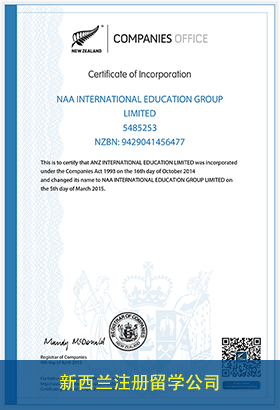
新西兰澳新教育集团(NAA International Education Group LTD.)是经新西兰官方正规注册留学教育公司...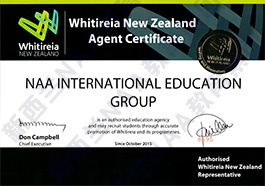
新西兰维特利亚理工学院官方授权
Whitireia New Zealand
新西兰维特利亚理工学院 Whitireia New Zealand
新西兰教育专家证书
Education New Zealand Trained ...
新西兰教育专家证书Education New Zealand Trained Agent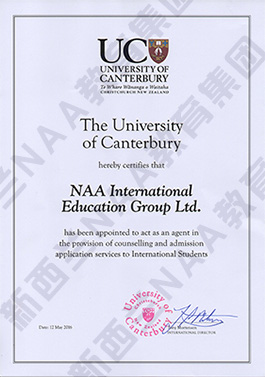
新西兰坎特伯雷大学官方授权
The University of Canterbury
新西兰坎特伯雷大学 The University of Canterbury-

-

Course details
Summary
With so many options to choose from, the Bachelor of Science degree (BSc) is your opportunity to create a good foundation for your study in the Earth, Chemical, Computational, Human, Life, Mathematical and Physical Sciences.
Modern science relies absolutely on applied mathematics. It is the job of an applied mathematician to show how mathematical techniques can be applied to science and technology to answer interesting questions. Our goal is to use mathematical equations to study real-world problems rather than to study equations for their own sake.
The Department of Mathematics uses mathematics to study such diverse areas as physiology, ice flow, floating runways, astronomy, quantum chemistry, nonlinear systems, the human genome and many other areas. Elements of these research areas are incorporated into our courses wherever possible.
Each of the courses in the Applied Mathematics programme deals with some aspect of the "Mathematical Models" that are used for describing problems from a variety of areas within Science and Technology. The core skills taught in these courses are:
There is a wealth of subjects on offer within the Bachelor of Science (BSc). The main areas include biological sciences, human sciences, earth sciences, computational sciences, physical sciences and health-orientated sciences. As well as skills that are part of your academic learning in your chosen major, you’ll have exposure to new technologies. This is the degree for you if you’re science-minded and want to keep your options open.
Programme highlights
Career opportunities
With a good degree in quantitative methods (mathematics, statistics, operations research and computing), career opportunities may include industry or government, computer development, insurance, meteorology, traffic engineering, systems analysis, computing programming, statistics, biometrics or operations research, and many other fields.
There is also currently a strong demand for mathematics teachers. You should aim for a balanced mathematics programme and bear in mind that versatility may be of more value to an employer than deep knowledge of one or two specialized topics.
Recent University of Auckland graduates work as/in:
Further study options
Structure
Single or first major must include:
45 points: MATHS 253, 260, 270
45 points: MATHS 340, 361, 363
at least 15 points from MATHS 332, 333, 362, STATS 310, 325, 370, ENGSCI 343, 391 and any other courses approved by the Head of Department
Second major must include:
at least 30 points from MATHS 253, 260, 270
45 points: MATHS 340, 361, 363
Entry criteria
Secondary school qualifications
You need to have one of the following:
International Baccalaureate Diploma with a minimum total score of 24.
General Certificate of Education (GCE) Advanced Level. You must have completed a minimum of three A-Level subjects with at least a 'C' grade or higher. General Studies or similar general papers cannot be included.
GCE ‘A’ Level requirements apply to ‘A’ Level qualifications examined by bodies such as AQA, OCR, Edexcel, WJEC, CCEA, Pearson Education Limited and CIE taken outside of New Zealand.
English language requirements:
IELTS 6.0; TOEFL (iBT) 80; TOEFL (paper-based) 550; CAE or CPE 169; PTE 50; MELAB 80.
Course variations
16-July-2018 - Grafton Campus
= 新西兰小学申请问题集 =