奥克兰大学/University of Auckland
- 课程名称:
Bachelor of Science (BSc) - Earth Sciences Major
- 课程级别:学士学位/Bachelor's Degree(7级)
- 课程代码:
- 学费:$33,688 NZD Per Year
- 学分:
- 开学时间:16-July-2018
- 申请截止:
- 授课校区:University of Auckland
- 课程信息:
- Earth surface forms and processes and their interaction including climate, water, terrestrial and biological systems
- How to interpret the geologic record as evidence of past events and environments
- How resources (coal, metallic, gas, thermal waters, etc.) form, where they occur, and how they are located and utilised
- The consequences of and perspectives around human interactions with the physical environment
- The range of qualitative and quantitative analytical methods available to solve problems in the Earth Science
- The role and importance of modelling in contemporary Earth science
- Bachelor of Science (Honours)
- Graduate Diploma in Science (GradDipSci)
- Postgraduate Diploma in Science (PGDipSci)
- Master of Science (MSc)
- Doctor of Philosophy (PhD)
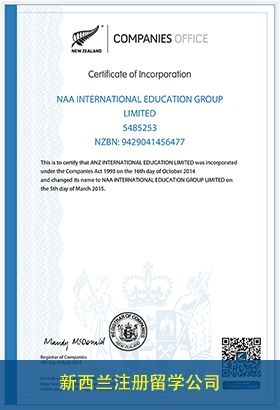
新西兰澳新教育集团
NAA International Education Gr...
新西兰澳新教育集团(NAA International Education Group LTD.)是经新西兰官方正规注册留学教育公司...
新西兰维特利亚理工学院官方授权
Whitireia New Zealand
新西兰维特利亚理工学院 Whitireia New Zealand
新西兰教育专家证书
Education New Zealand Trained ...
新西兰教育专家证书Education New Zealand Trained Agent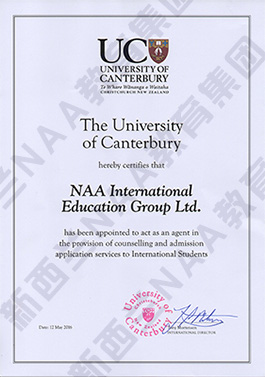
新西兰坎特伯雷大学官方授权
The University of Canterbury
新西兰坎特伯雷大学 The University of Canterbury-

-

Course details
Summary
The Earth Sciences major explores the processes that have shaped Earth, from its deepest interior to its surface, and into neighbouring space. It investigates the complexity and interactions of Earth’s systems, and addresses the impact of natural processes on society, and vice versa. Knowledge of Earth Science is important for, understanding how natural resources are formed, better stewardship of our environment and natural hazard risk management. Courses in the Earth Sciences programme explore such issues as Earth’s origin and evolution, plate tectonics, past life and climate environments, and the dynamic nature of earth surface and sub surface forms and processes and their interaction with the atmosphere, hydrosphere, cry sphere and biosphere. Earth Science also tackles issues of resource identification and use, encompassing mining, oil and gas exploration, and alternative energy.
The programme will equip you with an understanding of the complexity, interactions and relevance of earth sciences to the society you live and work in. The curriculum reflects trends in contributing disciplines and is relevant to today's strategic conversations and pressing global, regional and local issues, while preparing you for postgraduate study and the workforce.
When studying a BSc in Earth Sciences you will learn, among other things, about:
Career opportunities
The scientific study of our earth is more important now than ever. A large, increasing world population is demanding more energy, food and minerals from the planet. Urbanization and population pressure are making huge demands for buildings, infrastructure and water.
Trained Earth Scientists find employment locally and internationally, working for environmental consultancies, geological and exploration companies, engineering companies, territorial local authorities or the central government. Areas of work will include: geological surveys and mapping, geochemical and geophysical exploration, petroleum and natural gas location and assessment, coal field development, rock and mineral resources survey, mineral processing and mining, assessing natural hazards (volcanoes, earthquakes), environmental impact audits, engineering site investigations, land stability studies, oceanography and education.
Further study options
Structure
Single or first major must include:
30 points from: GEOG 101, EARTHSCI 103; At least 15 points from: MATHS 108, 110, 150, 162, STATS 101, 108, EARTHSCI 263; At least 15 points from: BIOSCI 101, 102, 104, 106, CHEM 110, 120, GEOG 210, PHYSICS 120, 121, 130, 160; At least 15 points from: EARTHSCI 201, EARTHSCI 260, etc.
Second major must include:
30 points from: EARTHSCI 103, GEOG 101; At least 15 points from: MATHS 108, 110, 150, 162, STATS 101, 108, EARTHSCI 263; At least 15 points from: BIOSCI 101, 102, 104, 106, CHEM 110, 120, GEOG 210, MATHS 108, 110, 150, 162, STATS 101, 108, etc.
Entry criteria
Secondary school qualifications
You need to have one of the following: International Baccalaureate Diploma with a minimum total score of 24. General Certificate of Education (GCE) Advanced Level. You must have completed a minimum of three A-Level subjects with at least a 'C' grade or higher. General Studies or similar general papers cannot be included.
GCE ‘A’ Level requirements apply to ‘A’ Level qualifications examined by bodies such as AQA, OCR, Edexcel, WJEC, CCEA, Pearson Education Limited and CIE taken outside of New Zealand.
English language requirements:
IELTS 6.0; TOEFL (iBT) 80; TOEFL (paper-based) 550; CAE or CPE 169; PTE 50; MELAB 80.
Course variations
16-July-2018 - Tamaki Innovation Campus
= 新西兰小学申请问题集 =