奥克兰大学/University of Auckland
- 课程名称:
Bachelor of Science (BSc) - Statistics Major
- 课程级别:学士学位/Bachelor's Degree(7级)
- 课程代码:
- 学费:$33,688 NZD Per Year
- 学分:
- 开学时间:16-July-2018
- 申请截止:
- 授课校区:University of Auckland
- 课程信息:
- Bachelor of Science (Honours)
- Graduate Diploma in Science (GradDipSci)
- Postgraduate Diploma in Science (PGDipSci)
- Master of Science (MSc)
- Doctor of Philosophy (PhD)

新西兰澳新教育集团
NAA International Education Gr...
新西兰澳新教育集团(NAA International Education Group LTD.)是经新西兰官方正规注册留学教育公司...
新西兰维特利亚理工学院官方授权
Whitireia New Zealand
新西兰维特利亚理工学院 Whitireia New Zealand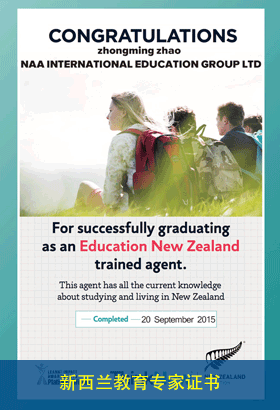
新西兰教育专家证书
Education New Zealand Trained ...
新西兰教育专家证书Education New Zealand Trained Agent
新西兰坎特伯雷大学官方授权
The University of Canterbury
新西兰坎特伯雷大学 The University of Canterbury-

-

Course details
Summary
Who needs statistics today and in the future? Anyone who wants to be able to look critically at numerical information and not be easily misled. Anyone who has problems to solve, problems they won’t be able to solve until they find out a little more about the world and how it operates - problems from finding ways to make a business more profitable right through to improving living standards and fighting cancer. Investigation - asking questions, designing ways to collect data to answer those questions, collecting data, making sense of what the data say to produce sensible answers - this is the subject matter of statistics and a set of general life skills.
We live in an information age. Computers allow us to collect and store information in quantities that previously would not even have been dreamt of. But raw, undigested data stored on computer disks are useless until people can start to make sense of them. Statistics is the human side of the computer revolution, an information science, the art and science of extracting meaning from seemingly incomprehensible data. Statistics applies to almost any field; this is why some training in statistics can help make you more effective and more employable, regardless of the career direction you choose.
This is a wealth of major, subjects and specialization on offer within the Bachelor of Science (BSc). The main areas include biological sciences, human and earth sciences, computational sciences, physical sciences and health-orientated sciences. As well as skills that are part of your academic learning in your chosen major, you’ll be exposed to new technologies including IT. This is the degree for you if you’re science-minded and want to keep your options open.
Career opportunities
Statistics is the ideal partner course for people who want to enhance their quantitative capabilities while pursuing their career choice subject. A second major in statistics, a minor in statistics or a conjoint degree with statistics can provide you with an employment advantage in almost any field: finance, psychology, economics, marketing, law, biology, accounting, journalism etc. To be employed as a specialist statistician you will probably need a postgraduate qualification in statistics.
Statisticians apply their skills in a wide range of industries; banks, insurance companies and other financial institutions, web-based and IT companies, market research organizations, pharmaceutical and other manufacturing companies, public health and utilities providers, Crown Research Institutes, government departments such as Treasury, Statistics New Zealand and MAF, local bodies, universities and technical institutes.
Across these organizations statisticians design studies, analyse data and make projections to better inform decisions. Successful statisticians often begin their careers in technical roles and are promoted into management. Consulting statisticians enjoy a wide diversity of statistical applications for problem solving. In one week a practicing statistician can help to investigate a case of disputed authorship, design an experiment to evaluate the effects of a new treatment for a disease, analyse a set of data gathered by an ecologist, and help a freight carrier to study work processes to find ways to make the company more profitable.
Further study options
Structure
First or single major must include:
15 points from STATS 125, 210
At least 60 points from STATS 301–390, or ENGSCI 391
Second major must include:
45 points from STATS 301-390
Entry criteria
Secondary school qualifications
You need to have one of the following: International Baccalaureate Diploma with a minimum total score of 24. General Certificate of Education (GCE) Advanced Level. You must have completed a minimum of three A-Level subjects with at least a 'C' grade or higher. General Studies or similar general papers cannot be included.
GCE ‘A’ Level requirements apply to ‘A’ Level qualifications examined by bodies such as AQA, OCR, Edexcel, WJEC, CCEA, Pearson Education Limited and CIE taken outside of New Zealand.
English language requirements:
IELTS 6.0; TOEFL (iBT) 80; TOEFL (paper-based) 550; CAE or CPE 169; PTE 50; MELAB 80.
Course variations
16-July-2018 - Tamaki Innovation Campus
= 新西兰小学申请问题集 =
上一课程:Bachelor of Science (BSc) - Psychology Major
下一课程:Bachelor of Science (Honours) (BSc(Hons)) in Applied Mathematics