奥克兰大学/University of Auckland
- 课程名称:
Master of Health Leadership (MHlthLd) in International Health
- 课程级别:硕士学位/Master's Degree(9级)
- 课程代码:
- 学费:$42,606 NZD Per Year
- 学分:
- 开学时间:16-July-2018
- 申请截止:
- 授课校区:Tamaki Innovation Campus
- 课程信息:
- Master of Health Sciences
- Master of Public Health
- Doctor of Philosophy
新西兰澳新教育集团
NAA International Education Gr...
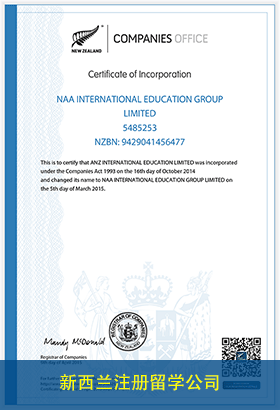
新西兰澳新教育集团(NAA International Education Group LTD.)是经新西兰官方正规注册留学教育公司...
新西兰维特利亚理工学院官方授权
Whitireia New Zealand
新西兰维特利亚理工学院 Whitireia New Zealand
新西兰教育专家证书
Education New Zealand Trained ...
新西兰教育专家证书Education New Zealand Trained Agent
新西兰坎特伯雷大学官方授权
The University of Canterbury
新西兰坎特伯雷大学 The University of Canterbury-

-

Course details
Summary
This is an innovative qualification for health professionals and graduates of health sciences, public health, commerce, law and arts degrees, who seek to improve the experiences of patients, the health of communities and populations, and the operations of health services.
Programme overview
Health leadership is a varied and complex field. If you are interested in a career where you can play a part in helping to improve the experiences of patients, the health of communities and the operations of health services, this is the ideal programme for you.
Study a wide range of topics from quality in health care to health care economics, public health principles and health informatics principles.
Health leadership opens doors in careers such as health management, health care quality improvement, international health management and more in this exciting challenging field.
International Health
The Faculty of Medical and Health Sciences offers two courses, POPLHLTH 715 Global Public Health and POPLHLTH 752 Case Studies in Global Health, which are directed to students with an interest in working with international governments, NGOs, philanthropic organizations or health care providers that are interested in ensuring the resources for health are shared equitably and put to the greatest benefit for all.
International students will appreciate the focus on health systems, governance arrangements and social dynamics of health and health care from across the WHO regions. In these two courses close look at what works, what doesn’t and why.
Areas of study
International Health is a specialization in the new 180 point Master of Health Leadership programme.
Study areas include the global burden of disease, health and human rights, global health ethics, international health systems, governance and financing, the role of NGOs, IGOS and the emerging place of philanthropic organisations, global health challenges for our Asia Pacific region and technology and policy solutions and strategies for health and development. We draw upon case studies, regional plans and current debates and unfolding global events to focus and keep our focus applied.
Outcomes
Students taking these two courses will learn to appreciate the interconnectedness of the geopolitical, the technological and economic drivers to health outcomes, particularly in low and middle income countries. The global epidemiological shift is examined to generate a detailed appreciation of the role of global systems and their impact on health.
Career opportunities
Graduates with a specialist training in international health systems have scope to work within governments, with regional Inter-government agencies (e.g. WHO), within NGOs, civil society agencies, with any of the major philanthropic organisations as well as in development agencies (the World Bank, Asia Development Bank).
Programme structure
The MHlthLd can be completed as a 120-point or 180-point taught masters degree, depending on the level of study you have completed.
The 180-point programme can be completed in three semesters (18 months) full-time or up to 12 semesters (6 years) part-time. The 120-point programme can be completed in two semesters (1 year) full-time or up to eight semesters (4 years) part-time.
Further study options
Entry criteria
Taught 120 points: Within the past five years you must have completed one year of postgraduate study, following an undergraduate degree, at a recognised university (or similar institution) with a GPE of 5.0. Your study must be in a relevant discipline and have included courses in population health, health management, health informatics and/or māori health.
Taught 180 points: You must have completed an undergraduate degree at a recognised university (or similar institution) in a relevant discipline with a GPE of 5.0. Relevant disciplines include all health professional degrees, and non-clinical degrees in approved subjects including public health, health sciences, health social sciences, commerce and law.
English language requirements:
IELTS 6.5; TOEFL (iBT) 90; TOEFL (paper-based) 575; CAE or CPE 176; PTE 58; MELAB 85.
Course variation
16-July-2018 - Tamaki Innovation Campus
= 新西兰小学申请问题集 =