奥克兰大学/University of Auckland
- 课程名称:
Master of Science (MSc) in Physics
- 课程级别:硕士学位/Master's Degree(9级)
- 课程代码:
- 学费:$39,584 NZD Per Year
- 学分:
- 开学时间:16-July-2018
- 申请截止:
- 授课校区:University of Auckland
- 课程信息:
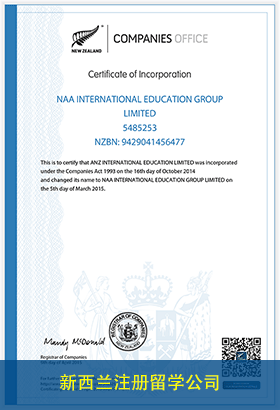
新西兰澳新教育集团
NAA International Education Gr...
新西兰澳新教育集团(NAA International Education Group LTD.)是经新西兰官方正规注册留学教育公司...
新西兰维特利亚理工学院官方授权
Whitireia New Zealand
新西兰维特利亚理工学院 Whitireia New Zealand
新西兰教育专家证书
Education New Zealand Trained ...
新西兰教育专家证书Education New Zealand Trained Agent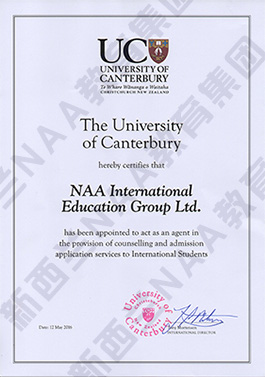
新西兰坎特伯雷大学官方授权
The University of Canterbury
新西兰坎特伯雷大学 The University of Canterbury-

-

Course details
Summary
The Master of Science (MSc) programme enables you to pursue advanced study in your area of interest with the opportunity to work on independent research.
Programme overview
Studying for an MSc is an opportunity for committed scientists to focus on a relevant area of interest or practise and pursue an advanced qualification. While taught masters will provide you with specialist training in your chosen field, a research masters will develop advanced research skills, working alongside Faculty of Science researchers - many of whom are major contributors in their field.
Physics
Physics is perhaps the most basic of all sciences. Understanding the principles of physics and the laws of nature gives you an enhanced insight into the world around you. All of modern science and technology is underpinned by physics. A degree in physics will give you an understanding of the nature of matter combined with training in experimental methods and the mathematical analysis of physical processes.
Lectures at postgraduate level include a choice of basic and specialised topics. The latter are closely related to the research interests (and therefore MSc thesis topics) in the Department, which include aspects of theoretical physics, nuclear physics, laser physics, optoelectronics, nonlinear fibre optics, teraherta spectroscopy, adaptive optics, quantum optics, atom optics, optical metrology, biophotonics, theoretical biology, condensed matter physics, marine acoustics, atmospheric and ionspheric physics, astrophysics, elementary particle physics, remote sensing, signal processing and physics education.
Career opportunities
Fundamental physics is a strong underpinning for careers in many branches of the physical sciences. Recent graduates are finding work in research-based jobs, and teaching, marketing, medical physics and computing. Mineral exploration physics and astrophysics are open to physics graduates.
Many aspects of computing and telecommunications require physics and a degree in physics would open up avenues in scientific instrument manufacture, electronics and development of computer systems.
Industrial applications of physics including noise control, industrial process monitoring and control, radiation monitoring, vibration analysis and water resource management.
Meteorology and oceanography are also interesting fields available to physicists.
Requirements: Research Masters
120 points: PHYSICS 796 MSc Thesis in Physics
Further study options
Doctor of Philosophy
Other Master of Science (MSc) Subjects
Applied Mathematics, Bioinformatics, Biological Sciences, Biomedical Science, Biosecurity and Conservation, Biotechnology, Chemistry, Clinical Exercise Physiology, Computer Science, Earth Sciences, Environmental Management, Environmental Science, Exercise Sciences, Food Science, Forensic Science, Geography, Geology, Geophysics, Logic and Computation, Marine Science, Mathematics, Medical Statistics, Optometry, Pharmacology, Physiology, Psychology, Speech Science, Sport and Exercise Science, Statistics, Wine Science.
Entry criteria
The prerequisite is a BSc(Hons) or PGDipSci in Physics.
English language requirements:
IELTS 6.5; TOEFL (iBT) 90; TOEFL (paper-based) 575; CAE or CPE 176; PTE 58; MELAB 85.Course variations
16-July-2018 - Grafton Campus
= 新西兰小学申请问题集 =