奥克兰大学/University of Auckland
- 课程名称:
科学研究生文凭Postgraduate Diploma in Science (PGDipSci) in Psychology
- 课程级别:研究生文凭/Postgraduate(8级)
- 课程代码:
- 学费:$41,415 NZD Per Year
- Master of Science
- Master of Speech Language Therapy Practice
- Master of Bioscience Enterprise
- Doctor of Philosophy
- Doctor of Clinical Psychology
新西兰澳新教育集团
NAA International Education Gr...
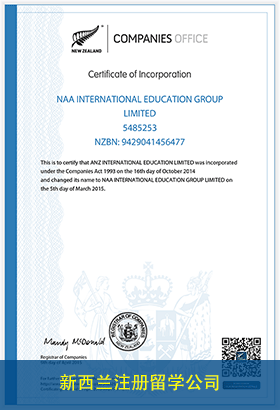
新西兰澳新教育集团(NAA International Education Group LTD.)是经新西兰官方正规注册留学教育公司...
新西兰维特利亚理工学院官方授权
Whitireia New Zealand
新西兰维特利亚理工学院 Whitireia New Zealand
新西兰教育专家证书
Education New Zealand Trained ...
新西兰教育专家证书Education New Zealand Trained Agent
新西兰坎特伯雷大学官方授权
The University of Canterbury
新西兰坎特伯雷大学 The University of Canterbury-

-

- 学分:
- 开学时间:16-July-2018
- 申请截止:
- 授课校区:University of Auckland
- 课程信息:
Course details
Summary
The Postgraduate Diploma in Science (PGDipSci) is an opportunity for Bachelor of Science graduates to advance their qualifications.
Psychology is the study of the mind and behaviour. It is a wide subject that ranges from, on the one hand, a strictly quantitative and scientific approach to, on the other, a more qualitative and personal approach. It also ranges from the strongly theoretical to the eminently practical.
Modern psychologists base their theories on observable and repeatable behavioural data, ranging from counts of simple behaviour in animals to verbal reports of emotions and feelings in humans. Thus, practical work in the laboratory or field is an essential part of an education in psychology.
At postgraduate level, the School of Psychology offers the following majors and specialization areas:
Applied Behaviour Analysis (ABA): ABA is a scientific approach to understanding and changing human behaviour and has applications with a wide variety of client groups including those with intellectual and other disabilities, autism spectrum, and childhood-onset behavioural disorders.
Industrial, Work & Organisational (IWO) Psychology: This area is concerned with the discovery and application of psychological principles to the workplace in order to maximize performance, productivity and wellbeing of workers and organisations.
Clinical Psychology: Clinical Psychology is a broad field of clinical practice and research within the discipline of psychology. The application of Clinical Psychology is aimed at preventing, treating, and reducing emotional and psychological problems, personality issues, and psychopathology and skill deficits underlying distress or psychological problems.
Health Psychology: Health Psychology covers areas such as how individuals cope with illness and chronic disease, understanding and promoting healthy behaviours, psychological influences on the development of disease states, understanding and improving adjustment in health-care settings, patient-practitioner communication, adherence to treatment, determinants of health-related behaviours (diet, exercise etc), and understanding how individuals make sense of and react to health screening, symptoms and illness.
Speech Science: Speech Science is intended for graduates with an interest in speech related areas. It is relevant to practising Speech Language Therapists with a bachelor’s degree, and also to those with backgrounds in linguistics, psychology, audiology, engineering, and computer science.
Career opportunities
Many avenues open up to graduates with training in psychology. Registered psychologists work in many aspects of mental health care, and clinical psychology. Jobs are available in the business environment involving the use of psychological tests, statistical analyses, or survey and questionnaire development. Staff recruitment, personnel training and evaluation are also areas which employ a lot of psychology graduates. Research careers can be developed in neural function and cognitive science.
Requirements:
120 points from PSYCH 691, 700-762
Or
105 points from PSYCH 691, 700-762
15 points, subject to approval by the Director of School, from approved 600 or 700 level courses in related subjects
Where could this programme take you?
Because science plays a vital role in addressing the key issues that confront us and future generations, studying the sciences opens up a wide range of career opportunities.
Further study options
Entry criteria
The prerequisite is a major in Psychology, or equivalent.
English language requirements: IELTS 6.5; TOEFL (iBT) 90; TOEFL (paper-based) 575; CAE or CPE 176; PTE 58; MELAB 85.
Course variations
16-July-2018 - Tamaki Innovation Campus
= 新西兰小学申请问题集 =
上一课程:科学研究生文凭Postgraduate Diploma in Science (PGDipSci) in Physiology
下一课程:科学研究生文凭Postgraduate Diploma in Science (PGDipSci) in Speech Science