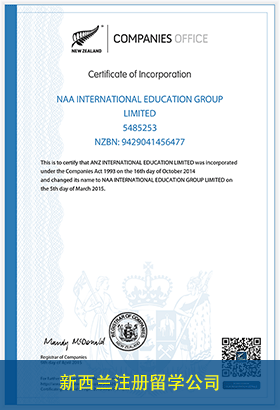
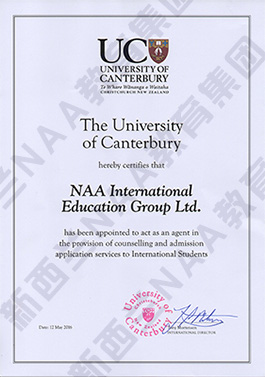
坎特伯雷大学/The University of Canterbury
- 课程名称:
商科Bachelor of Science (BSc) in Economics
- 课程级别:学士学位/Bachelor's Degree(7级)
- 课程代码:
- 学费:$30,300 NZD Per Year
- 学分:
- 开学时间:16-July-2018
- 申请截止:
- 授课校区:The University of Canterbury
- 课程信息:
- a minimum of 255 points of Science courses
- the remaining 105 points can be from either Science courses or courses from other degrees.
- At least 225 points must be from courses above 100-level, with at least 90 points at 300-level.
Course details
Summary
Economics is the study of how people behave. Every day, people and society are confronted by choices. Should you go to university or start a career? What should you do with your next dollar? Should the government raise the minimum wage, or not? How do we address the big issues in the world such as poverty and climate change?
Choices involve trade-offs where we are choosing between two things. The outcomes of choices have both costs and benefits to consider. Economics is the study of how people and societies make such decisions in the production, exchange, distribution and consumption of goods and services.
A Bachelor of Science (BSc) will extend your knowledge in multiple interest areas, satisfying many questions you may have about the world and encouraging you to investigate even further.
Qualification structure and duration
The Bachelor of Science requires a minimum total of 360 points:
Double Degrees
Many students combine the study of a BSc with another degree, such as a Bachelor of Arts, Bachelor of Commerce or a Bachelor of Laws. If you are considering a double degree you should get advice from the College of Science Student Advisor or the Liaison Office.
Career opportunities
Graduates in Economics find employment in many areas of government and business, where it is recognised that an economist's education provides valuable specialist training for a professional career as well as good general preparation and background for an executive, entrepreneurial or administrative career.
The increasingly large volume of information available to decision makers has created a demand for people with well-developed quantitative analysis skills, such as those developed in econometrics.
Professional economists are employed to conduct research and give advice on economic matters in various organisations such as government ministries and state-owned enterprises (eg, Treasury, Health, Social Development, Agriculture and Forestry, and Foreign Affairs and Trade). Graduates also find work in marketing organisations, the Reserve Bank, Statistics New Zealand, trading and merchant banks, stock broking, insurance, trade commissions, local authorities, market research and other consultancies, and large businesses.
Those who are passionate about economics and education can also go on to teaching careers in schools or universities.
Entry criteria
Admission to UC with University Entrance, or equivalent, is required to enrol for a Bachelor's degree. Applicants must have completed New Zealand University Entrance through NCEA; or Cambridge International Examinations (CIE); or International Baccalaureate Diploma (IB) or any other equivalent overseas qualification.
Recommended preparation
While previous study of economics is useful preparation, it is not essential to have studied this subject at secondary school.
Students can study Economics without having to take any mathematics. However, students who wish to keep open the option of progressing to postgraduate study in Economics are strongly advised to include calculus, statistics and modelling in their Year 13 programme.
A broad education, including history and English, is useful to develop the ability to write clearly and analyse written material.
Students with very good Year 13 results in economics may be offered direct entry to 200-level Economics courses at the discretion of the Head of Department.
Other English language requirements: TOEFL PBT with a minimum score of 550 and TWE with a minimum score of 4.5; CCEL EAP Level 2 with a minimum C+ grade; CAE or CPE minimum score of 169 with at least 162 in reading, writing, listening and speaking; Pearson Test of English (Academic) - PTE with an overall score of 57 and no PTE communicative skills score below 50.
= 新西兰小学申请问题集 =