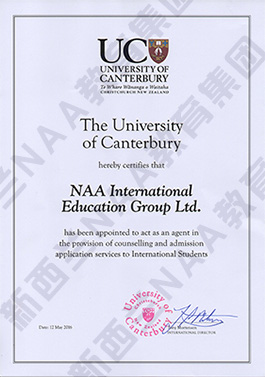
坎特伯雷大学/The University of Canterbury
- 课程名称:
Certificate in Science (CertSc) in Chemistry
- 课程级别:证书课程/Certificate(4级)
- 课程代码:
- 学费:$18,950 NZD Per Year
- 学分:
- 开学时间:16-July-2018
- 申请截止:
- 授课校区:The University of Canterbury
- 课程信息:
Course details
Summary
Chemistry is the central science. It deals with the composition, structure and behaviour of the atoms and molecules that make up all forms of matter. Understanding the world at an atomic level is essential to all areas of science. Chemistry interlinks and contributes to medicine, geology, materials science, molecular physics, biology and astronomy.
Its central role in science is emphasised by the fact that Chemistry merges with Biological Sciences (the field of biochemistry) at one extreme and with Physics (physical chemistry and chemical physics) at the other.
Chemistry propels advances in modern society and has an important role to play in solving major global challenges such as energy sustainability, food supply, health and the environment. Every day we utilise products developed by experimental chemists such as plastics, fabrics, petrol and pharmaceuticals.
The Department of Chemistry is equipped with excellent facilities both in undergraduate laboratories and for research work. Research activities in the department include investigations into such diverse topics as chemical biology, synthesis, supramolecular chemistry, theoretical and computational chemistry, surface and electrochemistry, trace elements in the environment, nanotechnology and new materials.
Courses
100-level courses
For most Science students core first-year Chemistry consists of two half-year courses:
CHEM111 Chemical Principles and Processes and
CHEM112 Structure and Reactivity
These build on, and expand, the basic framework provided by Year 12 and Year 13 chemistry. They provide a background for advanced courses in Chemistry and for courses in Engineering, Biochemistry, Biological Sciences, Environmental Science, Geology and Forestry.
200-level and beyond
200-level Chemistry courses develop and expand on the first-year material and give a deeper treatment of specialised areas such as organic and inorganic reactions, structural methods, and physical, environmental and analytical chemistry.
300-level courses build upon the practical and theoretical foundations established in the first two years to give students the ability to work with and understand the chemistry of complex systems and molecules. These courses emphasise the place of chemistry in the modern world and provide for the use of modern chemical instrumentation and analytical methods.
Career opportunities
New Zealand's unique mix of primary and secondary industries provides a wide choice of careers in chemistry. Expanding industries in New Zealand, for example those related to new sources of energy and to the development of forestry and dairy resources, are further increasing the demand for qualified chemists.
New Zealand needs chemists in teaching, industry, health and research.
Chemists are key members of developmental teams in the pharmaceutical industry.
Industry uses chemists in such areas as research and development of new products, monitoring product composition and quality, and environmental monitoring and regulation.
Hospitals and other health services employ chemists in areas such as biochemical research, medical analysis and toxicology.
A degree in Chemistry is a good start to a teaching career with its emphasis on laboratory work and its relevance to other sciences.
The majority of chemical research in New Zealand is done in universities, Crown Research Institutes and private laboratories.
Chemists are well trained in problem-solving and skilled at handling information, which leads naturally into a wide diversity of job opportunities including, for example, sales and management.
Further study
The Certificate in Science can be used as a stepping stone to a Bachelor of Science.
Entry criteria
Admission to UC with University Entrance, or equivalent, is required to enrol for a Certificate in Arts. Applicants must have completed New Zealand University Entrance through NCEA; or Cambridge International Examinations (CIE); or International Baccalaureate Diploma (IB) or any other equivalent overseas qualification.
Other English language requirements: TOEFL PBT with a minimum score of 550 and TWE with a minimum score of 4.5; CCEL EAP Level 2 with a minimum C+ grade; CAE or CPE minimum score of 169 with at least 162 in reading, writing, listening and speaking; Pearson Test of English (Academic) - PTE with an overall score of 57 and no PTE communicative skills score below 50.
= 新西兰小学申请问题集 =