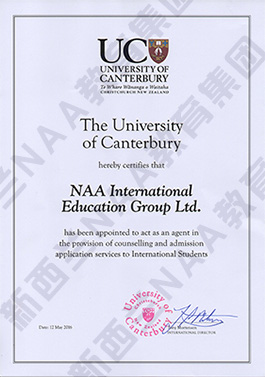
坎特伯雷大学/The University of Canterbury
- 课程名称:
科学研究生文凭Graduate Diploma in Science (Physics)
- 课程级别:学士后文凭/Graduate(7级)
- 课程代码:
- 学费:$30,300 NZD Per Year
- 学分:
- 开学时间:16-July-2018
- 申请截止:
- 授课校区:The University of Canterbury
- 课程信息:
- building huge laser equipment to study gravitational waves
- creating tiny nanoelectronic devices that can act as transistors or sensors
- measuring the behaviour of the upper atmosphere in order to understand global warming
- obtaining fundamental theoretical understandings of cosmology and sub-atomic physics.
Course details
Summary
What type of student might consider a Physics degree? Famous UC alumnus, Ernest Rutherford, was intrigued in childhood by seeing a stick apparently bend when dipped into a farm bucket of water; Albert Einstein asked how his face would appear in a hand-held mirror if he ran at some significant fraction of the speed of light. A budding physicist may share this fascination with and curiosity about the natural world.
Physics aims to understand the behaviour of matter and energy from the scale of subatomic particles to that of the Universe itself. From computers to communication systems, architecture to agriculture; modern life is overwhelmingly built using the understanding of nature that physics provides.
We are currently in an incredibly exciting period in Physics. The technological advances of the last 20 years have had an enormous impact on all our lives and almost all of these advances rely on advances in Physics. Modern physics provides a framework for understanding - and contributing to - major advances in technology now and in the future.
This diploma offers people who hold a bachelor's degree in a major in an unrelated area the opportunity to study science in-depth. It is designed to provide a qualification for graduates seeking to qualify for entry to postgraduate qualifications in science, change career direction, or to extend or upgrade their existing qualifications.
UC physicists are currently involved in the following exciting projects:
Qualification structure and duration
Students take courses from the Bachelor of Science schedule and are required to pass courses totalling a minimum of 120 points including 90 points at 300-level.
Further study
This qualification is an ideal pathway into postgraduate study.
Career opportunities
Many of our graduates are employed as physicists and can be found at Crown Research Institutes, the National Radiation Laboratory, medical physics departments of hospitals, or universities and the Meteorological Service among others.
Some Physics graduates are not employed as scientists however - their analytical skills, numeracy and all-round thinking ability are in demand in many industries. Some of these graduates are snapped up by the IT and electronics industries, but those same skills are equally valued by merchant banks, stock brokers and other financial services companies, as well as by the armed services, police and aerospace industries (including airlines like Air New Zealand). Teaching, journalism and science communication also need people with physics training.
Entry criteria
Graduate diplomas require a bachelor's degree. If you gained your qualifications overseas, these will need to be assessed to ensure they are of an equivalent standard.
Other English language requirements: TOEFL PBT with a minimum score of 550 and TWE with a minimum score of 4.5; CCEL EAP Level 2 with a minimum C+ grade; CAE or CPE minimum score of 169 with at least 162 in reading, writing, listening and speaking; Pearson Test of English (Academic) - PTE with an overall score of 57 and no PTE communicative skills score below 50.
= 新西兰小学申请问题集 =