坎特伯雷大学/The University of Canterbury
- 课程名称:
PhD - Doctor of Philosophy in Chemistry
- 课程级别:博士学位/Doctoral Degree(10级)
- 课程代码:
- 学费:$7,440 NZD Per Year
- Chemists are key members of developmental teams in the pharmaceutical industry.
- Industry uses chemists in such areas as research and development of new products, monitoring product composition and quality, and environmental monitoring and regulation.
- Hospitals and other health services employ chemists in areas such as biochemical research, medical analysis and toxicology.
- A degree in Chemistry is a good start to a teaching career with its emphasis on laboratory work and its relevance to other sciences.
- The majority of chemical research in New Zealand is done in universities, Crown Research Institutes and private laboratories. These institutions provide chemical challenges equal to any in the world.
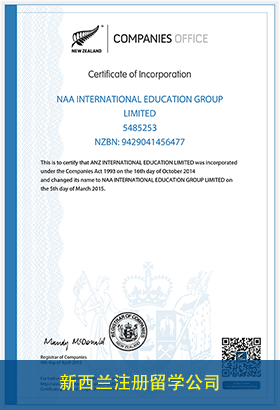
新西兰澳新教育集团
NAA International Education Gr...
新西兰澳新教育集团(NAA International Education Group LTD.)是经新西兰官方正规注册留学教育公司...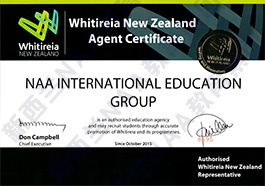
新西兰维特利亚理工学院官方授权
Whitireia New Zealand
新西兰维特利亚理工学院 Whitireia New Zealand
新西兰教育专家证书
Education New Zealand Trained ...
新西兰教育专家证书Education New Zealand Trained Agent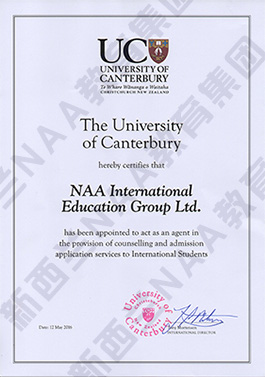
新西兰坎特伯雷大学官方授权
The University of Canterbury
新西兰坎特伯雷大学 The University of Canterbury-

-

- 学分:
- 开学时间:16-July-2018
- 申请截止:
- 授课校区:The University of Canterbury
- 课程信息:
Course details
Summary
Chemistry is the central science. It deals with the composition, structure and behaviour of the atoms and molecules that make up all forms of matter. Understanding the world at an atomic level is essential to all areas of science. Chemistry interlinks and contributes to medicine, geology, materials science, molecular physics, biology and astronomy.
Its central role in science is emphasised by the fact that Chemistry merges with Biological Sciences (the field of biochemistry) at one extreme and with Physics (physical chemistry and chemical physics) at the other.
Chemistry propels advances in modern society and has an important role to play in solving major global challenges such as energy sustainability, food supply, health and the environment. Every day we utilise products developed by experimental chemists such as plastics, fabrics, petrol and pharmaceuticals.
The UC Doctor of Philosophy (PhD) is a research-only degree carried out under expert supervision and using world-class facilities.
A PhD involves extensive, sustained and original research and study in your chosen subject, with the results being presented in a thesis that will contribute to intellectual knowledge of the field. It is a mark of intellectual ability, self-discipline and commitment. A PhD prepares you for a number of careers, including as an academic.
The minimum period of enrolment for a full-time candidate is two years and the maximum period four years; most PhD students take between three and three-and-a-half years.
Career opportunities
New Zealand's unique mix of primary and secondary industries provides a wide choice of careers in chemistry. Expanding industries in New Zealand, for example those related to new sources of energy and to the development of forestry and dairy resources, are further increasing the demand for qualified chemists.
New Zealand needs chemists in teaching, industry, health and research.
Chemists are well trained in problem-solving and skilled at handling information, which leads naturally into a wide diversity of job opportunities including, for example, sales and management.
Entry criteria
Enrolment in a PhD requires completion of a research-focused honours or master's degree at first-class or second-class division 1 level (or equivalent qualifications). Applicants with qualifications from outside New Zealand must have been granted admission to the University.
Other English language requirements: TOEFL PBT with a minimum score of 575 and TWE with a minimum score of 4.5; CCEL EAP Level 2 with a minimum B+ grade; CAE or CPE score of 176 with a minimum of 169 in reading, writing, listening and speaking; Pearson Test of English (Academic) - PTE with an overall score of 64 and no PTE communicative skills score below 58.
= 新西兰小学申请问题集 =