奥克兰大学/University of Auckland
- 课程名称:
工程Master of Engineering Studies in Environmental Engineering
- 课程级别:硕士学位/Master's Degree(9级)
- 课程代码:
- 学费:$39,584 NZD Per Year
- 学分:
- 开学时间:16-July-2018
- 申请截止:
- 授课校区:University of Auckland
- 课程信息:
- Master of Engineering
- Doctor of Philosophy
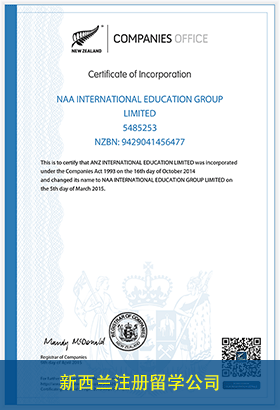
新西兰澳新教育集团
NAA International Education Gr...
新西兰澳新教育集团(NAA International Education Group LTD.)是经新西兰官方正规注册留学教育公司...
新西兰维特利亚理工学院官方授权
Whitireia New Zealand
新西兰维特利亚理工学院 Whitireia New Zealand
新西兰教育专家证书
Education New Zealand Trained ...
新西兰教育专家证书Education New Zealand Trained Agent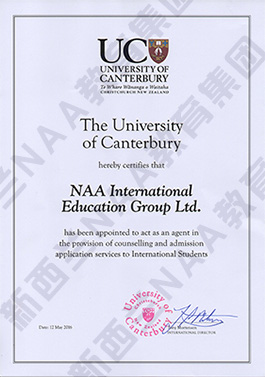
新西兰坎特伯雷大学官方授权
The University of Canterbury
新西兰坎特伯雷大学 The University of Canterbury-

-

Course details
Summary
Enhance your employability in the competitive global market with a qualification that provides advanced technical foundations and industrial perspectives in your chosen field.
Programme overview
The Master of Engineering Studies in Environmental Engineering provides graduates with an in-depth understanding of the field of environmental engineering, and a pathway into a career in this field.
A fully taught master, this programme provides students with the opportunity to further their knowledge within the field of environmental engineering. The programme consists of courses and small research projects in the areas of environmental impact assessment, waste minimization and management, and protection of air, water, and soil from pollution.
Programme structure
Option A - 120 points
at least 45 points from ENVENG 701–703, 705, 746, 747, 750, 787–789, 795, but no more than 45 points from ENVENG 787–789, 795
up to 75 points from ENVENG 706, 707, 719, 740, 744, 752
up to 30 points from appropriate ENVSCI 600 and 700 level courses, subject to approval by the Head of Department
up to 30 points from appropriate 600 and 700 level courses offered at this University, subject to approval by the Head of Department
Option B - 180 points
at least 45 points from ENVENG 701–703, 705, 746, 747, 750, 787–789, 795, but no more than 60 points from ENVENG 787–789, 795
up to 75 points from ENVENG 706, 707, 719, 740, 744, 752
up to 45 points from appropriate ENVSCI 600 and 700 level courses, subject to approval by the Head of Department
up to 45 points from appropriate 600 and 700 level courses offered at this University, subject to approval by the Head of Department
Career opportunities
A degree in Environmental Engineering will provide you with the skills to develop and communicate solutions to environmental problems by applying principles of engineering, physics, mathematics, microbiology, and chemistry. The environmental engineering profession offers diverse options for employment in consultancy and research organisations, local and national government bodies (e.g., local councils and central ministries), and international organisations (e.g., Asian Development Bank, World Bank, and United Nations). Employment options spans a broad range of disciplines catering to a wide breadth of technical and soft skills (e.g., treatment system design, impact assessment reports, policy development, public engagement and feedback) that are needed by local as well as multinational organisations. An environmental section plays a key role in all engineering consultancy firms, and a number of purely environmental engineering firms have become established, with over 30 such firms now existing in Auckland alone. Past graduates of MEngSt in Environmental Engineering have been employed in the water and wastewater industry, solid waste management sector, design consultancy organisations, environmental impact roles, local and regional councils, Ministry for the Environment, office of the Parliamentary Commissioner for the Environment, Greenpeace, and organisations overseas.
Further study options
Other Master of Engineering Studies subjects:
Chemical and Materials Engineering, Civil Engineering, Computer Systems Engineering, Construction Management, Electrical and Electronic Engineering, Engineering Science, Food Process Engineering, Geotechnical Engineering, Light Metals Reduction Technology, Mechanical Engineering, Mechatronics Engineering, Medical Devices and Technologies, Plastics, Software Engineering, Transportation Engineering.
Entry criteria
Anybody with a suitable undergraduate degree in Engineering, Science or Mathematics may consider applying for this programme.
English language requirements:
IELTS 6.5; TOEFL (iBT) 90; TOEFL (paper-based) 575; CAE or CPE 176; PTE 58; MELAB 85.
Course variations
16-July-2018 - Grafton Campus
= 新西兰小学申请问题集 =
上一课程:Master of Engineering Studies in Engineering Science
下一课程:Master of Engineering Studies in Food Process Engineering