奥克兰大学/University of Auckland
- 课程名称:
Master of Science (MSc) in Statistics
- 课程级别:硕士学位/Master's Degree(9级)
- 课程代码:
- 学费:$39,584 NZD Per Year
- 学分:
- 开学时间:16-July-2018
- 申请截止:
- 授课校区:Grafton Campus
- 课程信息:
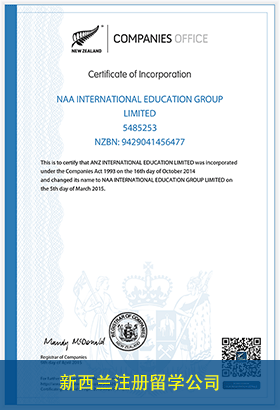
新西兰澳新教育集团
NAA International Education Gr...
新西兰澳新教育集团(NAA International Education Group LTD.)是经新西兰官方正规注册留学教育公司...
新西兰维特利亚理工学院官方授权
Whitireia New Zealand
新西兰维特利亚理工学院 Whitireia New Zealand
新西兰教育专家证书
Education New Zealand Trained ...
新西兰教育专家证书Education New Zealand Trained Agent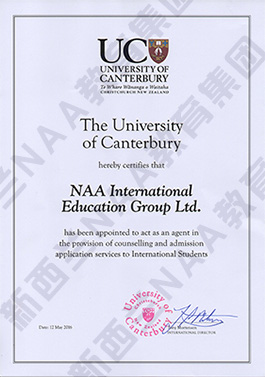
新西兰坎特伯雷大学官方授权
The University of Canterbury
新西兰坎特伯雷大学 The University of Canterbury-

-

Course details
Summary
The Master of Science (MSc) programme enables you to pursue advanced study in your area of interest with the opportunity to work on independent research.
Programme overview
Studying for an MSc is an opportunity for committed scientists to focus on a relevant area of interest or practise and pursue an advanced qualification. While taught masters will provide you with specialist training in your chosen field, a research masters will develop advanced research skills, working alongside Faculty of Science researchers - many of whom are major contributors in their field.
Statistics
Statistics is important for anyone who wants to be able to look critically at numerical information and not be easily misled. It is important for anyone who has problems to solve, problems they won't be able to solve until they find out a little more about the world and how it operates - from finding ways to make a business more profitable right through to improving living standards and fighting cancer.
Our recent graduates have found employment in industry, research institutes, medical research teams, government departments, market research companies, insurance companies, investment banks, and in universities. For many of these jobs, a postgraduate degree has been essential.
Career opportunities
The sheer diversity of applications of statistics makes it exciting. In one week, a practicing statistician could help to investigate a case of disputed authorship, design an experiment to evaluate the effects of a new treatment for a disease, analyse a set of data gathered by an ecologist, and help a freight carrier to study his or her work processes to find ways of making the company more profitable.
One of the more interesting applications of statistics which leads to employment is Operations Research. This involves the development of ways of managing large systems. This may involve cost minimisation or modelling and forecasting, and be applied to such fields as inventory control, scheduling problems, production planning or faming such as bids for contracts or political campaigns. It may deal with issues such as reliability of equipment, location problems, or how to service customers to best advantage.
Statisticians are found in all branches of Government and commerce, particularly those students who opt to do a conjoint degree with Commerce. Other avenues are in product testing, market research and advertising.
Requirements: Research Masters
90 points: STATS 798 Masters Thesis in Statistics
30 points, subject to approval by the Head of Department, from 600 or 700 level courses in Statistics or related subjects
Taught Masters
30 points: STATS 790 Masters Dissertation 1
15 points: STATS 732
At least 45 points from STATS 701–787, BIOINF 704, POPLHLTH 702, 707–709, 711
Up to 30 points from 700 level courses in Statistics or related subjects, as approved by the Head of Department
Further study options
Doctor of Philosophy
Other Master of Science (MSc) Subjects
Applied Mathematics, Bioinformatics, Biological Sciences, Biomedical Science, Biosecurity and Conservation, Biotechnology, Chemistry, Clinical Exercise Physiology, Computer Science, Earth Sciences, Environmental Management, Environmental Science, Exercise Sciences, Food Science, Forensic Science, Geography, Geology, Geophysics, Logic and Computation, Marine Science, Mathematics, Medical Statistics, Optometry, Pharmacology, Physics, Physiology, Psychology, Speech Science, Sport and Exercise Science, Wine Science.
Entry criteria
The prerequisite is a PGDipSci in Speech Science, or equivalent as approved by the Chair of the Board of Studies.
English language requirements:
IELTS 6.5; TOEFL (iBT) 90; TOEFL (paper-based) 575; CAE or CPE 176; PTE 58; MELAB 85.Course variations
16-July-2018 - Leigh Marine Campus
= 新西兰小学申请问题集 =