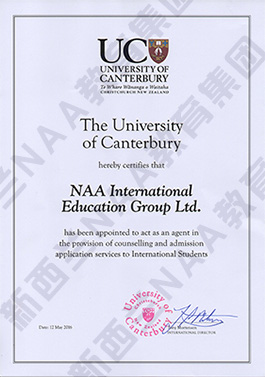
坎特伯雷大学/The University of Canterbury
- 课程名称:
科学研究生文凭Graduate Diploma in Science (Astronomy)
- 课程级别:学士后文凭/Graduate(7级)
- 课程代码:
- 学费:$30,300 NZD Per Year
- 学分:
- 开学时间:16-July-2018
- 申请截止:
- 授课校区:The University of Canterbury
- 课程信息:
Course details
Summary
Astronomy and astrophysics are concerned with the study of the nature and distribution of matter and radiation throughout all time and space in the Universe. Astronomers have always been keen to harness the latest technological advances in their quest for ever more precise and revealing observations. As a consequence, astronomy in recent years has been one of the most rapidly expanding of all physical sciences and many exciting and unexpected discoveries continue to be made.
This diploma offers people who hold a bachelor's degree in a major in an unrelated area the opportunity to study science in-depth. It is designed to provide a qualification for graduates seeking to qualify for entry to postgraduate qualifications in science, change career direction, or to extend or upgrade their existing qualifications.
The GradDipSc may be awarded with Distinction.
Qualification structure and duration
Students take courses from the Bachelor of Science schedule and are required to pass courses totalling a minimum of 120 points including 90 points at 300-level.
Further study
This qualification is an ideal pathway into postgraduate study.
Career opportunities
Students majoring in Astronomy acquire a wide range of skills, from the use of spectroscopic and photometric detector systems (and the analysis of the data obtained), through electronics and optics, to computer skills for analysis and interpretation of data. This produces a graduate who is well equipped to undertake employment not only in astronomy, but in any number of fields which require practical experience or which involve analysis of real data.
Studying Physics and Astronomy equips graduates with skills in problem solving, abstract thinking, evaluating, communicating and decision making. It develops high levels of curiosity, inventiveness, and mathematical and computer competencies.
Graduates may follow traditional paths and work either as scientists, technicians, research assistants, engineers, astronomers, patent agents, technical authors or even managers at an observatory or in an institute. However, many Astronomy graduates move into other fields, particularly computing and information technology, management, and science communication or media work. With some additional study graduates can become meteorologists, geophysicists, material technologists or medical physicists.
Entry criteria
Graduate diplomas require a bachelor's degree. If you gained your qualifications overseas, these will need to be assessed to ensure they are of an equivalent standard.
Other English language requirements: TOEFL PBT with a minimum score of 550 and TWE with a minimum score of 4.5; CCEL EAP Level 2 with a minimum C+ grade; CAE or CPE minimum score of 169 with at least 162 in reading, writing, listening and speaking; Pearson Test of English (Academic) - PTE with an overall score of 57 and no PTE communicative skills score below 50.
= 新西兰小学申请问题集 =